Showing posts with label web. Show all posts
Showing posts with label web. Show all posts
Saturday, March 6, 2010
Wednesday, October 28, 2009

Thursday, September 24, 2009
Guess Which Economy Doubled in Size Last Year
Believe it or not, the virtual economy of Second Life, a popular online computer game that lets users create a new reality for themselves, doubled in size last year. Users spent more than a billion dollars on virtual goods over the last year, compared to $360 million for the year before.
Second Life's economy is now larger than the economies of nations such as East Timor, Samoa and Dijibouti.
Second Life's economy is now larger than the economies of nations such as East Timor, Samoa and Dijibouti.

Tuesday, June 23, 2009
Tuesday, June 16, 2009

Sunday, May 10, 2009
The Grid, Our Cars and the Net: One Idea to Link Them All
The Grid, Our Cars and the Net: One Idea to Link Them All | Autopia

By David Weinberger 
May 8, 2009
11:57 am
May 8, 2009
11:57 am

Editor's note: Robin Chase thinks a lot about transportation and the internet, and how to link them. She connected them when she founded Zipcar, and she wants to do it again by making our electric grid and our cars smarter. Time magazine recently named her one of the 100 most influential people of the year. David Weinberger sat down with Chase to discuss her idea.
Robin Chase considers the future of electricity, the future of cars and the internet three terms in a single equation, even if most of us don't yet realize they're on the same chalkboard. Solve the equation correctly, she says, and we create a greener future where innovation thrives. Get it wrong, and our grandchildren will curse our names.
Chase thinks big, and she's got the cred to back it up. She created an improbable network of automobiles called Zipcar. Getting it off the ground required not only buying a fleet of cars, but convincing cities to dedicate precious parking spaces to them. It was a crazy idea, and it worked. Zipcar now has 6,000 cars and 250,000 users in 50 towns.
Now she's moving on to the bigger challenge of integrating a smart grid with our cars – and then everything else. The kicker is how they come together. You can sum it up as a Tweet: The intelligent network we need for electricity can also turn cars into nodes. Interoperability is a multiplier. Get it right!
Robin Chase
Chase starts by explaining the smart grid. There's broad consensus that our electrical system should do more than carry electricity. It should carry information. That would allow a more intelligent, and efficient, use of power.
"Our electric infrastructure is designed for the rare peak of usage," Chase says. "That's expensive and wasteful."
Changing that requires a smart grid. What we have is a dumb one. We ask for electricity and the grid provides it, no questions asked. A smart grid asks questions and answers them. It makes the meter on your wall a sensor that links you to a network that knows how much power you're using, when you're using it and how to reduce your energy needs – and costs.
Such a system will grow more important as we become energy producers, not just consumers. Electric vehicles and plug-in hybrids will return power to the grid. Rooftop solar panels and backyard wind turbines will, at times, produce more energy than we can store. A smart grid generates what we need and lets us use what we generate. That's why the Obama Administration allocated $4.5 billion in the stimulus bill for smart grid R&D.
This pleases Chase, but it also makes her nervous. The smart grid must be an information network, but we have a tradition of getting such things wrong. Chase is among those trying to convince the government that the safest and most robust network will use open internet protocols and standards. For once the government seems inclined to listen.
Chase switches gears to talk about how cars fit into the equation. She sees automobiles as just another network device, one that, like the smart grid, should be open and net-based.
"Cars are network nodes," she says. "They have GPS and Bluetooth and toll-both transponders, and we're all on our cell phones and lots of cars have OnStar support services."
That's five networks. Automakers and academics will bring us more. They're working on smart cars that will communicate with us, with one another and with the road. How will those cars connect to the network? That's the third part of Chase's equation: Mesh networking.
In a typical Wi-Fi network, there's one router and a relatively small number of devices using it as a gateway to the internet. In a mesh network, every device is also a router. Bring in a new mesh device and it automatically links to any other mesh devices within radio range. It is an example of what internet architect David Reed calls "cooperative gain" - the more devices, the more bandwidth across the network. Chase offers an analogy to explain it.
"Wi-Fi is like a bridge that connects the highways on either side of the stream," she says. "You build it wide enough to handle the maximum traffic you expect. If too much comes, it gets congested. When not enough arrives, you've got excess capacity. Mesh takes a different approach: Each person who wants to cross throws in a flat rock that's above the water line. The more people who do that, the more ways there are to get across the river."
Cooperative gain means more users bring more capacity, not less. It's always right-sized. Of course, Chase points out, if you're trying to go a long distance, you're ultimately forced back onto the broadband bridge where the capacity is limited. But for local intra-mesh access, it's a brilliant and counter-intuitive strategy.
Mesh networking as a broad-based approach to networking is growing. A mesh network with 240 nodes covers Vienna. Similar projects are underway in Barcelona, Athens, the Czech Republic and, before long, in two areas of Boston not far from the cafe we're sitting in. But the most dramatic examples are the battlefields of Iraq and Afghanistan.
"Today in Iraq and Afghanistan, soldiers and tanks and airplanes are running around using mesh networks," said Chase. "It works, it's secure, it's robust. If a node or device disappears, the network just reroutes the data."
And, perhaps most important, it's in motion. That's what allows Chase's plural visions to go singular. Build a smart electrical grid that uses Internet protocols and puts a mesh network device in every structure that has an electric meter. Sweep out the half dozen networks in our cars and replace them with an open, Internet-based platform. Add a mesh router. A nationwide mesh cloud will form, linking vehicles that can connect with one another and with the rest of the network. It's cooperative gain gone national, gone mobile, gone open.
Chase's mesh vision draws some skepticism. Some say it won't scale up. The fact it's is being used in places like Afghanistan and Vienna indicates it could. Others say moving vehicles may not be able to hook into and out of mesh networks quickly enough. Chase argues it's already possible to do so in less than a second, and that time will only come down. But even if every car and every electric meter were meshed, there's still a lot of highway out there that wouldn't be served, right? Chase has an answer for that, too.
"Cars would have cellular and Wi-Fi as backups," she said.
The economics are right, she argues. Rather than over-building to handle peak demand and letting capacity go unused, we would right-size our infrastructure to provide exactly what we need, when we need it, with minimum waste and maximum efficiency.
"There's an economy of network scale here," she says. "The traffic-light guys should be interested in this for their own purposes, and so should the power-grid folks and the emergency responders and the Homeland Security folks and, well, everyone. Mesh networks based on open standards are economically justifiable for any one of these things. Put them together - network the networks – and for the same exact infrastructure spend, you get a ubiquitous, robust, resilient, open communication platform — ripe for innovation — without spending a dollar more."
The time is right, too. There's $7.2 billion in the stimulus bill for broadband, $4.5 billion for the smart grid and about $5 billion for transportation technology. The Transportation Reauthorization bill is coming up, too. At $300 billion it is second only to education when it comes to federal discretionary spending. We are about to make a huge investment in a set of networks. It will be difficult to gather the political and economic will to change them once they are deployed.
"We need to get this right, right now," Chase says.
Build each of these infrastructures using open networking standards and we enable cooperative gain at the network level itself. Get it wrong and we will have paved over a generational opportunity.
David Weinberger is a fellow at Harvard's Berkman Center for Internet and Society. E-mail him at self@evident.com.
Friday, May 1, 2009
Wolfram on Wolfram Alfa
March 5, 2009
"Some might say that Mathematica and A New Kind of Science are ambitious projects.
But in recent years I’ve been hard at work on a still more ambitious project—called Wolfram|Alpha.
And I’m excited to say that in just two months it’s going to be going live:
Mathematica has been a great success in very broadly handling all kinds of formal technical systems and knowledge.

But what about everything else? What about all other systematic knowledge? All the methods and models, and data, that exists?
Fifty years ago, when computers were young, people assumed that they’d quickly be able to handle all these kinds of things and that one would be able to ask a computer any factual question, and have it compute the answer.
But it didn’t work out that way. Computers have been able to do many remarkable and unexpected things. But not that.
I’d always thought, though, that eventually it should be possible. And a few years ago, I realized that I was finally in a position to try to do it.
I had two crucial ingredients: Mathematica and NKS. With Mathematica, I had a symbolic language to represent anything—as well as the algorithmic power to do any kind of computation. And with NKS, I had a paradigm for understanding how all sorts of complexity could arise from simple rules.
But what about all the actual knowledge that we as humans have accumulated?
A lot of it is now on the web—in billions of pages of text. And with search engines, we can very efficiently search for specific terms and phrases in that text.
But we can’t compute from that. And in effect, we can only answer questions that have been literally asked before. We can look things up, but we can’t figure anything new out.
So how can we deal with that? Well, some people have thought the way forward must be to somehow automatically understand the natural language that exists on the web. Perhaps getting the web semantically tagged to make that easier.
But armed with Mathematica and NKS I realized there’s another way: explicitly implement methods and models, as algorithms, and explicitly curate all data so that it is immediately computable.
It’s not easy to do this. Every different kind of method and model—and data—has its own special features and character. But with a mixture of Mathematica and NKS automation, and a lot of human experts, I’m happy to say that we’ve gotten a very long way.
How can I say it?
"But, OK. Let’s say we succeed in creating a system that knows a lot, and can figure a lot out. How can we interact with it?
The way humans normally communicate is through natural language. And when one’s dealing with the whole spectrum of knowledge, I think that’s the only realistic option for communicating with computers too.
Of course, getting computers to deal with natural language has turned out to be incredibly difficult. And for example we’re still very far away from having computers systematically understand large volumes of natural language text on the web.
But if one’s already made knowledge computable, one doesn’t need to do that kind of natural language understanding.
All one needs to be able to do is to take questions people ask in natural language, and represent them in a precise form that fits into the computations one can do.
Of course, even that has never been done in any generality. And it’s made more difficult by the fact that one doesn’t just want to handle a language like English: one also wants to be able to handle all the shorthand notations that people in every possible field use.
I wasn’t at all sure it was going to work. But I’m happy to say that with a mixture of many clever algorithms and heuristics, lots of linguistic discovery and linguistic curation, and what probably amount to some serious theoretical breakthroughs, we’re actually managing to make it work.
Neverending trillions
"Pulling all of this together to create a true computational knowledge engine is a very difficult task.
It’s certainly the most complex project I’ve ever undertaken. Involving far more kinds of expertise—and more moving parts—than I’ve ever had to assemble before.
And—like Mathematica, or NKS—the project will never be finished.
But I’m happy to say that we’ve almost reached the point where we feel we can expose the first part of it.
It’s going to be a website: www.wolframalpha.com. With one simple input field that gives access to a huge system, with trillions of pieces of curated data and millions of lines of algorithms.
We’re all working very hard right now to get Wolfram|Alpha ready to go live.
I think it’s going to be pretty exciting. A new paradigm for using computers and the web.
That almost gets us to what people thought computers would be able to do 50 years ago!
Due Soon: Wolfram Alpha
Wolfram Alpha is an answer-engine developed by the international company Wolfram Research. The service will be an online computational data engine based on intuitive query parsing, a large library of algorithms, and A New Kind of Science approach to answering queries.[1] It was announced in March 2009 by British physicist Stephen Wolfram, to be launched in May 2009.
Wolfram Alpha differs from search engines in that it does not simply return a list of results based on a keyword, but instead computes answers and relevant visualizations from a collection of known information. Other new search engines, known collectively as semantic search engines, have developed alpha applications of this type, which index a large amount of answers, and then try to match the question to one. Examples of companies using this strategy include True Knowledge, and Microsoft's Powerset.
Wolfram Alpha has many parallels with Cyc, a project aimed at developing a common-sense inference engine since the 80s, though without producing any major commercial application. Cyc founder Douglas Lenat was one of the few given an opportunity to test Wolfram Alpha before its release:
It handles a much wider range of queries than Cyc, but much narrower than Google; it understands some of what it is displaying as an answer, but only some of it ... The bottom line is that there are a large range of queries it can't parse, and a large range of parsable queries it can't answer
-Douglas Lenat[2]
Wolfram's earlier flagship product Mathematica encompasses computer algebra, numerical computation, visualization and statistics capabilities and can be used on all kinds of mathematical analysis, from simple plotting to signal processing, but will not be included in the alpha release, due to computation-time problems.[3]
Saturday, March 28, 2009

Sunday, March 8, 2009

Monday, March 2, 2009
Wednesday, February 18, 2009
Serão descendentes de portuguêses??
Primeiro eu esbarrei no seguinte link patrocinado que, convenhamos, soa muuuuito estranho:
Fui verificar e era o site de um prestador de serviço de risk management de saúde. Alguém teve a brilhante idéia de chamar dar o atraente nome de "disease management" a "risk management de saúde".
No site dos gajos há várias seções interessantes. Uma delas (está no menu assim) é:
Acho que é mesmo para ser piada. Acho.
Numa outra seção, eles "premiam" empresas que fazem muitos erros em seus programas de risk... digo, disease management. O nome do prêmio? Intelligent Design!
Bom, aí eu acho que eles REALMENTE estão de sacanagem com os fundamentalistas cristãos (which is fine). A questão é: isso é bom marketing??
Continuando na tradição de um eestilo de redação bizarro, a descrição do Intelligent Design Award é:
Now, is this convoluted or what?
Como será o pensamento desses caras? Seguirá uma lógica própria, diferente da humana? Serão descendentes de portugueses?
Disease Mgmt Consulting
DM Consulting/Procurement Expertise for insurors, employers, PPOs, TPAs
www.dismgmt.com
www.dismgmt.com
Fui verificar e era o site de um prestador de serviço de risk management de saúde. Alguém teve a brilhante idéia de chamar dar o atraente nome de "disease management" a "risk management de saúde".
No site dos gajos há várias seções interessantes. Uma delas (está no menu assim) é:
Free Materials
(Worth Every Penny)
(Worth Every Penny)
Acho que é mesmo para ser piada. Acho.
Numa outra seção, eles "premiam" empresas que fazem muitos erros em seus programas de risk... digo, disease management. O nome do prêmio? Intelligent Design!
Bom, aí eu acho que eles REALMENTE estão de sacanagem com os fundamentalistas cristãos (which is fine). A questão é: isso é bom marketing??
Continuando na tradição de um eestilo de redação bizarro, a descrição do Intelligent Design Award é:
Intelligent Design Awards recognize those contributions which most set back evolution of the disease management and wellness fields.
Now, is this convoluted or what?
Como será o pensamento desses caras? Seguirá uma lógica própria, diferente da humana? Serão descendentes de portugueses?
Monday, January 5, 2009

Saturday, January 3, 2009
Sunday, November 30, 2008


Tuesday, November 25, 2008
E-Suicide

Adapted from GREG RISLING; copyright © 2008 The Associated Press.
LOS ANGELES — A Missouri mother is accused of conspiring to harass a 13-year-old girl with Internet messages that allegedly prompted her suicide.
Megan Meier was allegedly drawn into the Internet ruse devised by Lori Drew, the mother of Megan's one-time best friend.Lori Drew is accused of conspiring with her daughter, Sarah, then 13, and her 18-year-old assistant to cause emotional distress to Megan.
Drew has pleaded not guilty to one count of conspiracy and three counts of accessing computers without authorization. She could be sentenced to as many as 20 years in prison if convicted of all counts.
U.S. Attorney Thomas O'Brien portrayed Drew, 49, as the guiding force in a "mean" plan to humiliate Megan by inventing a make-believe boy named "Josh Evans" who would woo her on the MySpace Web site, then be revealed as nonexistent.
"Lori Drew decided to humiliate a child," O'Brien said in his summation. "The only way she could harm this pretty little girl was with a computer. She chose to use a computer to hurt a little girl and for four weeks she enjoyed it."
The defense said the case is a matter of computer law and accused prosecutors of misleading jurors into thinking it was a murder case.
"If you hadn't heard the indictment read to you, you'd think this was a homicide case," said Dean Steward, a defense attorney. "And it's not a homicide case. This, ladies and gentlemen, is a computer case, and that's what you need to decide."
Steward insisted the only question is whether Drew violated the terms-of-service agreement of MySpace. He said that Drew, her daughter and assistant Ashley Grills never read the seven-page agreement.
"Nobody reads these things, nobody," he said. "How can you violate something when you haven't even read it? End of case. The case is over."
The hoax ended with Megan never finding out that her online boyfriend did not exist. On Oct. 16, 2006, a message was sent from "Josh" to Megan telling her the world would be better off without her.
Shortly afterward, the girl went to her room and hanged herself in a closet. She died the next day.
The case is being prosecuted in Los Angeles because MySpace computer servers are based in the area.
Monday, November 24, 2008
Bedtime stories go online
Jemima Kiss, guardian.co.uk,
Thursday November 20 2008 12.17 GMT
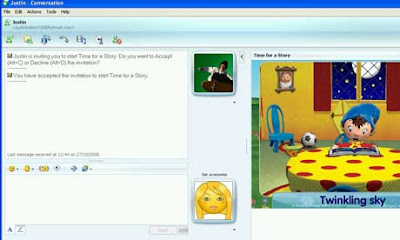

Noddy on Windows Live Messenger: Mr Men and Paddington Bear are also set to be adapted for the tool
Thursday November 20 2008 12.17 GMT

Noddy on Windows Live Messenger: Mr Men and Paddington Bear are also set to be adapted for the tool
Bedtime stories may never be the same after the launch of an online tool to let parents and children who cannot be together share classic tales.
Built by entertainment company Chorion for the Noddy stories, Time for a Story lets parents and grandparents contact a child through Windows Live Messenger and lead them through a digital version of stories about the character.
Chorion is initially releasing three Noddy stories through the application, with more planned. Mr Men and Paddington Bear are also scheduled to be adapted for the tool – although they may target at an older age group than the two- to five-year-olds Noddy is aimed at.
It is thought grown-ups in their 30s may also sign up for a dose of nostalgia based around their favourite childhood characters.
Time for a Story, developed by agency Digital Outlook, is being promoted through the Mumsnet community website, which took part in a trial of the application, and also on the MSN website, which gives a demonstration of the tool.
Users in the UK can access the stories through the "activities" tab in Windows Live Messenger. Parents control the speed of the story by clicking through pages, while the child can interact with pictures and words on screen for each part of the story.
"The kernel of the idea was from a producer who was working late a lot and not getting home to speak to his child, and ended up talking to them through IM," said a Chorion spokeswoman.
"There's no way we're saying this should replace that one-to-one contact or reading to a child while you are there, but we are trying to create a tool that allows parents or grandparents to interact with the child in a meaningful way when they can't be there."
The spokeswoman added that the tool provided a structure to the conversation through the form of the story – which would allow even very young children to benefit, and because instant messenger enables video chat it provided an emotional connection.
Tuesday, May 20, 2008
Nosso Amigo em Kathmandu
Como quase tudo na minha vida, meu gosto por sites é fortemente influenciado (contaminado?) pelos meus interesses e minha vida profissional – não sou muito bom em separar vida pessoal e profissional. Talvez por isso, um site em que sou bem ativo é o www.ask500people.com.
O Ask500People é um site de pesquisas ininterruptas, pela Internet. Você e dezenas de outras pessoas postam perguntas de múltipla escolha, que vão recebendo votos dos usuários, como você. As perguntas mais votadas vão subindo na “fila”, até que são “lançadas”. Então, pessoas de todo o mundo começam a responder à sua pergunta. Mais recentemente, passou a ser possível votar nas perguntas, enquanto elas ainda estão na fila.
Eu acho a coisa muito cool – você bola uma pergunta, pessoas julgam se ela é interessante, sua pergunta vai “ao ar” e centenas de pessoas ao redor do mundo tiram a dúvida que você tinha sobre como elas são, o que elas pensam, sentem, desejam, temem. Eu já teria ficado viciado na brincadeira, se a primeira versão beta do site não fosse bastante lenta. Agora não é mais e o risco de que eu gaste muitas preciosas horas de meus finais de semana ou noites, brincando de perguntar coisas às pessoas aumentou.
Outra coisa que melhorou muito é o número de respostas. Apesar dos 500, do nome, no começo a votação se encerrava quando chegava a 100 respostas. Agora, com a progressiva popularização do site, muitas perguntas estão chegando perto de receber as 500 respostas desejadas.
Além da real limitação do tamanho da amostra, no começo, eu também desconfiava do perfil dos respondentes: “Humm...”, eu pensava. “Com certeza, amostra viezada – deve ser uma garotada, ou uns computer geeks”. Então postei a pergunta: “Como você se define?”.
Surpresa: 56% dos usuários, ao redor do mundo, têm mais de 30 anos. Heavy-users de Internet, realmente são: 71%. Mas, mesmo entre esses, 62% têm mais de 30 anos.
OK. Então são pessoas maduras, bastante conectadas à Web. Minha próxima pergunta foi mais ousada: “Eu...
...nunca me encontrei com alguém que conheci através da Internet” – 44%
...me encontrei com várias pessoas que conheci via Internet” – 27%
...fiz sexo com alguém que conheci na Internet” – 19%
...casei com alguém que conheci na Internet” – 10%
Uau! Um em cada dez casou-se com alguém que conheceu via Web! Considerando que 32% dos usuários não são casados (segundo verifiquei por outras perguntas), na verdade o número de “casados via web”, entre os casados, é praticamente 1 em cada 7. Será verdade?
Consultando o livro “Microtrends”, do especialista em pesquisas americano Mark J. Penn, descubro (no capítulo “Internet Marrieds”!) que cerca de um em cada 43 casamentos americanos, realizados em 2007, foram de casais que se conheceram pela Web. Se o número de casais-web estiver dobrando a cada ano, há mais um casal, nesses 43, casado antes de 2007. Isso nos leva a um número de 1 casal-web em cada 21 ou 22 casais americanos. Um em cada 7 a 10, na população dos usuários Ask500People não parece, portanto, desarrazoado.
Não que o pessoal seja todo americano. A maioria é, principalmente nas perguntas que “vão ao ar” em horários em que a Europa está dormindo, quando as respostas de americanos podem chegar a quase 80%. E as diferenças nas respostas de diferentes países, como não podia deixar de ser, muitas vezes são marcantes.
Por exemplo, certa vez perguntei: “Você tem que escolher entre dois vinhos, de mesmo preço e da mesma variedade (digamos, Merlot). Qual você escolhe? Um excelente vinho, de um grande produtor global, ou um vinho muito bom (mas não excelente), de um produtor tradicional, de terroir”.
Como era de se esperar, todos os franceses e alemães disseram que escolheriam o vinho de terroir. Americanos e ingleses foram menos unânimes, mas cerca de 55% também escolheriam o vinho tradicional. Já na India, a tendência é oposta: dois terços prefeririam o “vinhão” globalizado. Já em países como Canadá, Egito e Arábia Saudita, o pessoal radicaliza: todos os respondentes escolheriam o “vinhão”. Talvez o pessoal desses países, de clima também “radical”, não tenham muito apreço pela idéia de “terroir”.
Uma outra pergunta (essa não foi minha) que também revelou diferenças regionais interessantes foi: “Você é mais cândido com alguns amigos on-line, do que com seu/sua melhor amigo(a), parceiro(a) ou esposa(o)?”.
Mais de 70% dos americanos, franceses e canadenses e mais de 60% dos ingleses e japoneses disseram que não (algo me diz que, os franceses, por uma razão diferente dos demais...). Os coreanos ficaram no meio-a-meio. Nós, brasileiros, nossos vizinhos argentinos e os italianos já viramos para o outro lado: cerca de 60% de nós “nos abrimos” mais on-line do que ao vivo. Aí os mexicanos, marroquinos, argerianos e outros “vão para as cabeças” – 90% a 100% soltam a língua, mesmo, é na web.
E o que esse universo de interneteiros globais, maduros mas modernos, de idéias liberais mas comportamento um tanto conservador, pensa do Brasil? Perguntei (e essa foi minha pergunta que recebeu mais votos, para “ir ao ar”): “Brasil é...
...um país significativo, no concerto das nações (redação deliberadamente pretenciosa) – espantosos (pelo menos para mim) 48% optaram por essa resposta.
Em compensação, 37% responderam que “não têm idéia do que é ou onde fica o Brasil” (13%), ou que “o Brasil é um país marginal e sem importância” (24%).
E os 15% restantes? Esses responderam que o Brasil “é um lugar onde gostariam de viver”.
Apesar de um terço dos coreanos desejar viver no Brasil, metade não sabe onde ficamos e o restante nos considera um país sem importância. Já a metade dos canadenses e australianos – e 51% dos americanos – nos consideram muito importantes (o único argentino que respondeu, também).
E, então, tem essa pessoa em Kathmandu, no Nepal. Será um homem? Uma mulher? Não tenho como saber, mas uma coisa eu sei: ele ou ela gostaria de viver no Brasil.
Friday, November 24, 2000
The Screen People of Tomorrow (cont.)
An emerging set of cheap tools is now making it easy to create digital video. There were more than 10 billion views of video on YouTube in September. The most popular videos were watched as many times as any blockbuster movie. Many are mashups of existing video material. Most vernacular video makers start with the tools of Movie Maker or iMovie, or with Web-based video editing software like Jumpcut. They take soundtracks found online, or recorded in their bedrooms, cut and reorder scenes, enter text and then layer in a new story or novel point of view. Remixing commercials is rampant. A typical creation might artfully combine the audio of a Budweiser “Wassup” commercial with visuals from “The Simpsons” (or the Teletubbies or “Lord of the Rings”). Recutting movie trailers allows unknown auteurs to turn a comedy into a horror flick, or vice versa.
Rewriting video can even become a kind of collective sport. Hundreds of thousands of passionate anime fans around the world (meeting online, of course) remix Japanese animated cartoons. They clip the cartoons into tiny pieces, some only a few frames long, then rearrange them with video editing software and give them new soundtracks and music, often with English dialogue. This probably involves far more work than was required to edit the original cartoon but far less work than editing a clip a decade ago. The new videos, called Anime Music Videos, tell completely new stories. The real achievement in this subculture is to win the Iron Editor challenge. Just as in the TV cookoff contest “Iron Chef,” the Iron Editor must remix videos in real time in front of an audience while competing with other editors to demonstrate superior visual literacy. The best editors can remix video as fast as you might type.
In fact, the habits of the mashup are borrowed from textual literacy. You cut and paste words on a page. You quote verbatim from an expert. You paraphrase a lovely expression. You add a layer of detail found elsewhere. You borrow the structure from one work to use as your own. You move frames around as if they were phrases.
Digital technology gives the professional a new language as well. An image stored on a memory disc instead of celluloid film has a plasticity that allows it to be manipulated as if the picture were words rather than a photo. Hollywood mavericks like George Lucas have embraced digital technology and pioneered a more fluent way of filmmaking. In his “Star Wars” films, Lucas devised a method of moviemaking that has more in common with the way books and paintings are made than with traditional cinematography.
In classic cinematography, a film is planned out in scenes; the scenes are filmed (usually more than once); and from a surfeit of these captured scenes, a movie is assembled. Sometimes a director must go back for “pickup” shots if the final story cannot be told with the available film. With the new screen fluency enabled by digital technology, however, a movie scene is something more flexible: it is like a writer’s paragraph, constantly being revised. Scenes are not captured (as in a photo) but built up incrementally. Layers of visual and audio refinement are added over a crude outline of the motion, the mix constantly in flux, always changeable. George Lucas’s last “Star Wars” movie was layered up in this writerly way. He took the action “Jedis clashing swords — no background” and laid it over a synthetic scene of a bustling marketplace, itself blended from many tiny visual parts. Light sabers and other effects were digitally painted in later, layer by layer. In this way, convincing rain, fire and clouds can be added in additional layers with nearly the same kind of freedom with which Lucas might add “it was a dark and stormy night” while writing the script. Not a single frame of the final movie was left untouched by manipulation. In essence, a digital film is written pixel by pixel.The recent live-action feature movie “Speed Racer,” while not a box-office hit, took this style of filmmaking even further. The spectacle of an alternative suburbia was created by borrowing from a database of existing visual items and assembling them into background, midground and foreground. Pink flowers came from one photo source, a bicycle from another archive, a generic house roof from yet another. Computers do the hard work of keeping these pieces, no matter how tiny and partial they are, in correct perspective and alignment, even as they move. The result is a film assembled from a million individual existing images. In most films, these pieces are handmade, but increasingly, as in “Speed Racer,” they can be found elsewhere.
In the great hive-mind of image creation, something similar is already happening with still photographs. Every minute, thousands of photographers are uploading their latest photos on the Web site Flickr. The more than three billion photos posted to the site so far cover any subject you can imagine; I have not yet been able to stump the site with a request. Flickr offers more than 200,000 images of the Golden Gate Bridge alone. Every conceivable angle, lighting condition and point of view of the Golden Gate Bridge has been photographed and posted. If you want to use an image of the bridge in your video or movie, there is really no reason to take a new picture of this bridge. It’s been done. All you need is a really easy way to find it.
Similar advances have taken place with 3D models. On Google SketchUp’s 3D Warehouse, you can find insanely detailed three-dimensional virtual models of most major building structures of the world. Need a street in San Francisco? Here’s a filmable virtual set. With powerful search and specification tools, high-resolution clips of any bridge in the world can be circulated into the common visual dictionary for reuse. Out of these ready-made “words,” a film can be assembled, mashed up from readily available parts. The rich databases of component images form a new grammar for moving images.
After all, this is how authors work. We dip into a finite set of established words, called a dictionary, and reassemble these found words into articles, novels and poems that no one has ever seen before. The joy is recombining them. Indeed it is a rare author who is forced to invent new words. Even the greatest writers do their magic primarily by rearranging formerly used, commonly shared ones. What we do now with words, we’ll soon do with images.
For directors who speak this new cinematographic language, even the most photo-realistic scenes are tweaked, remade and written over frame by frame. Filmmaking is thus liberated from the stranglehold of photography. Gone is the frustrating method of trying to capture reality with one or two takes of expensive film and then creating your fantasy from whatever you get. Here reality, or fantasy, is built up one pixel at a time as an author would build a novel one word at a time. Photography champions the world as it is, whereas this new screen mode, like writing and painting, is engineered to explore the world as it might be.
But merely producing movies with ease is not enough for screen fluency, just as producing books with ease on Gutenberg’s press did not fully unleash text. Literacy also required a long list of innovations and techniques that permit ordinary readers and writers to manipulate text in ways that make it useful. For instance, quotation symbols make it simple to indicate where one has borrowed text from another writer. Once you have a large document, you need a table of contents to find your way through it. That requires page numbers. Somebody invented them (in the 13th century). Longer texts require an alphabetic index, devised by the Greeks and later developed for libraries of books. Footnotes, invented in about the 12th century, allow tangential information to be displayed outside the linear argument of the main text. And bibliographic citations (invented in the mid-1500s) enable scholars and skeptics to systematically consult sources. These days, of course, we have hyperlinks, which connect one piece of text to another, and tags, which categorize a selected word or phrase for later sorting.All these inventions (and more) permit any literate person to cut and paste ideas, annotate them with her own thoughts, link them to related ideas, search through vast libraries of work, browse subjects quickly, resequence texts, refind material, quote experts and sample bits of beloved artists. These tools, more than just reading, are the foundations of literacy.
If text literacy meant being able to parse and manipulate texts, then the new screen fluency means being able to parse and manipulate moving images with the same ease. But so far, these “reader” tools of visuality have not made their way to the masses. For example, if I wanted to visually compare the recent spate of bank failures with similar events by referring you to the bank run in the classic movie “It’s a Wonderful Life,” there is no easy way to point to that scene with precision. (Which of several sequences did I mean, and which part of them?) I can do what I just did and mention the movie title. But even online I cannot link from this sentence to those “passages” in an online movie. We don’t have the equivalent of a hyperlink for film yet. With true screen fluency, I’d be able to cite specific frames of a film, or specific items in a frame. Perhaps I am a historian interested in oriental dress, and I want to refer to a fez worn by someone in the movie “Casablanca.” I should be able to refer to the fez itself (and not the head it is on) by linking to its image as it “moves” across many frames, just as I can easily link to a printed reference of the fez in text. Or even better, I’d like to annotate the fez in the film with other film clips of fezzes as references.
With full-blown visuality, I should be able to annotate any object, frame or scene in a motion picture with any other object, frame or motion-picture clip. I should be able to search the visual index of a film, or peruse a visual table of contents, or scan a visual abstract of its full length. But how do you do all these things? How can we browse a film the way we browse a book?
It took several hundred years for the consumer tools of text literacy to crystallize after the invention of printing, but the first visual-literacy tools are already emerging in research labs and on the margins of digital culture. Take, for example, the problem of browsing a feature-length movie. One way to scan a movie would be to super-fast-forward through the two hours in a few minutes. Another way would be to digest it into an abbreviated version in the way a theatrical-movie trailer might. Both these methods can compress the time from hours to minutes. But is there a way to reduce the contents of a movie into imagery that could be grasped quickly, as we might see in a table of contents for a book?
Academic research has produced a few interesting prototypes of video summaries but nothing that works for entire movies. Some popular Web sites with huge selections of movies (like porn sites) have devised a way for users to scan through the content of full movies quickly in a few seconds. When a user clicks the title frame of a movie, the window skips from one key frame to the next, making a rapid slide show, like a flip book of the movie. The abbreviated slide show visually summarizes a few-hour film in a few seconds. Expert software can be used to identify the key frames in a film in order to maximize the effectiveness of the summary.
The holy grail of visuality is to search the library of all movies the way Google can search the Web. Everyone is waiting for a tool that would allow them to type key terms, say “bicycle + dog,” which would retrieve scenes in any film featuring a dog and a bicycle. In an instant you could locate the moment in “The Wizard of Oz” when the witchy Miss Gulch rides off with Toto. Google can instantly pinpoint desirable documents out of billions on the Web because computers can read text, but computers are only starting to learn how to read images.It is a formidable task, but in the past decade computers have gotten much better at recognizing objects in a picture than most people realize. Researchers have started training computers to recognize a human face. Specialized software can rapidly inspect a photograph’s pixels searching for the signature of a face: circular eyeballs within a larger oval, shadows that verify it is spherical. Once an algorithm has identified a face, the computer could do many things with this knowledge: search for the same face elsewhere, find similar-looking faces or substitute a happier version.
Of course, the world is more than faces; it is full of a million other things that we’d like to have in our screen vocabulary. Currently, the smartest object-recognition software can detect and categorize a few dozen common visual forms. It can search through Flickr photos and highlight the images that contain a dog, a cat, a bicycle, a bottle, an airplane, etc. It can distinguish between a chair and sofa, and it doesn’t identify a bus as a car. But each additional new object to be recognized means the software has to be trained with hundreds of samples of that image. Still, at current rates of improvement, a rudimentary visual search for images is probably only a few years away.
What can be done for one image can also be done for moving images. Viewdle is an experimental Web site that can automatically identify select celebrity faces in video. Hollywood postproduction companies routinely “read” sequences of frames, then “rewrite” their content. Their custom software permits human operators to eradicate wires, backgrounds, unwanted people and even parts of objects as these bits move in time simply by identifying in the first frame the targets to be removed and then letting the machine smartly replicate the operation across many frames.
The collective intelligence of humans can also be used to make a film more accessible. Avid fans dissect popular movies scene by scene. With maniacal attention to detail, movie enthusiasts will extract bits of dialogue, catalog breaks in continuity, tag appearances of actors and track a thousand other traits. To date most fan responses appear in text form, on sites like the Internet Movie Database. But increasingly fans respond to video with video. The Web site Seesmic encourages “video conversations” by enabling users to reply to one video clip with their own video clip. The site organizes the sprawling threads of these visual chats so that they can be read like a paragraph of dialogue.
The sheer number of user-created videos demands screen fluency. The most popular viral videos on the Web can reach millions of downloads. Success garners parodies, mashups or rebuttals — all in video form as well. Some of these offspring videos will earn hundreds of thousands of downloads themselves. And the best parodies spawn more parodies. One site, TimeTube, offers a genealogical view of the most popular videos and their descendants. You can browse a time line of all the videos that refer to an original video on a scale that measures both time and popularity. TimeTube is the visual equivalent of a citation index; instead of tracking which scholarly papers cite other papers, it tracks which videos cite other videos. All of these small innovations enable a literacy of the screen.
As moving images become easier to create, easier to store, easier to annotate and easier to combine into complex narratives, they also become easier to be remanipulated by the audience. This gives images a liquidity similar to words. Fluid images made up of bits flow rapidly onto new screens and can be put to almost any use. Flexible images migrate into new media and seep into the old. Like alphabetic bits, they can be squeezed into links or stretched to fit search engines, indexes and databases. They invite the same satisfying participation in both creation and consumption that the world of text does.
We are people of the screen now. Last year, digital-display manufacturers cranked out four billion new screens, and they expect to produce billions more in the coming years. That’s one new screen each year for every human on earth. With the advent of electronic ink, we will start putting watchable screens on any flat surface. The tools for screen fluency will be built directly into these ubiquitous screens.
With our fingers we will drag objects out of films and cast them in our own movies. A click of our phone camera will capture a landscape, then display its history, which we can use to annotate the image. Text, sound, motion will continue to merge into a single intermedia as they flow through the always-on network. With the assistance of screen fluency tools we might even be able to summon up realistic fantasies spontaneously. Standing before a screen, we could create the visual image of a turquoise rose, glistening with dew, poised in a trim ruby vase, as fast as we could write these words. If we were truly screen literate, maybe even faster. And that is just the opening scene.Kevin Kelly is senior maverick at Wired and the author of “Out of Control” and a coming book on what technology wants.
Subscribe to:
Posts (Atom)